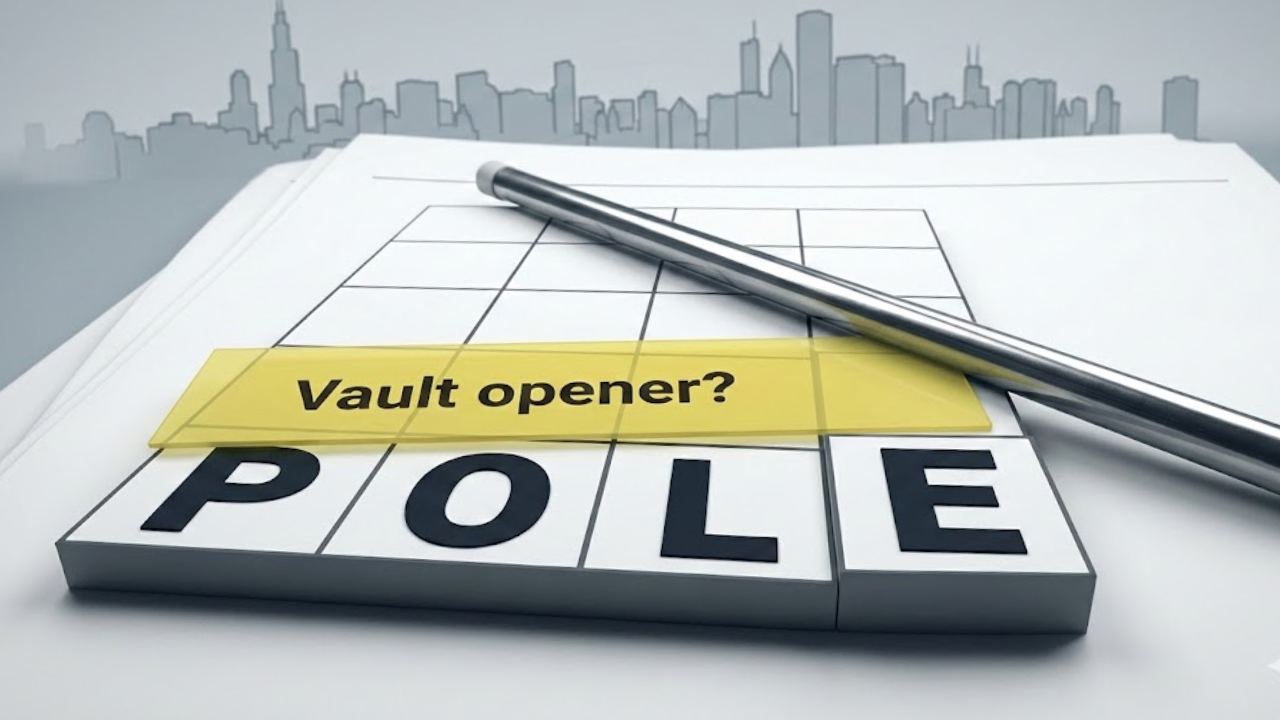
Stuck on “Vault Opener” NYT crossword clue? Discover all possible answers (POLE, ESS, KEY, ATM), solving strategies, wordplay tricks, and expert tips to crack this recurring puzzle favourite every time.
I stared at “Vault opener?” in my Friday NYT crossword for what felt like an eternity. Four letters. The question mark suggested wordplay, but my brain kept cycling through SAFE, LOCK, CODE—nothing fit. Three intersecting answers later, I had P-O-L-E staring back at me, and suddenly the cleverness hit. Not a bank vault at all. Pole vault. The athletic event where a pole literally “opens” or initiates the vault action.
That moment of revelation—that satisfying click when wordplay resolves into elegance—defines why millions tackle the New York Times crossword daily. But “Vault opener?” represents more than a single clever clue. It’s a recurring puzzle favorite that has stumped solvers since its first appearance, evolving through multiple interpretations depending on puzzle theme, day of the week difficulty, and constructor creativity.
Understanding this clue requires recognizing crossword conventions, mastering double-meaning wordplay, and building a mental library of common answers that rotate through NYT puzzles year after year. Whether you encountered this clue today or you’re building solving skills for future encounters, this comprehensive guide decodes every aspect of “Vault opener?” and transforms it from puzzle roadblock into confident solve.
Understanding the Clue: Why “Vault Opener?” Is Genius Wordplay
The New York Times crossword, launched in 1942, has evolved into America’s premier wordplay challenge. Unlike straightforward puzzles that reward vocabulary alone, NYT crosswords demand lateral thinking, pattern recognition, and comfort with ambiguity. The “Vault opener?” clue exemplifies this philosophy perfectly.
At surface level, “vault” triggers immediate associations: bank vaults, secure storage, combination locks, keys. The brain naturally gravitates toward security-related answers because that’s the most familiar context for the word “vault.” This predictable mental pathway is precisely what makes the clue effective—it misdirects solvers away from alternative meanings.
The question mark appended to “Vault opener?” serves as the constructor’s wink to experienced solvers. In crossword convention, question marks signal wordplay, puns, or non-literal interpretations. They’re the puzzle’s way of saying, “Don’t take this at face value.” Spotting that punctuation immediately should trigger a mental shift from literal thinking to creative interpretation.
The word “vault” itself contains multiple legitimate definitions, each opening doors to different answer possibilities. It can reference a secure storage space, an architectural arch, an athletic leap, or even a metaphorical repository of knowledge. This semantic richness gives constructors flexibility to use “Vault opener?” across various puzzle themes while maintaining plausible answers.
The Most Common Answer: POLE (And Why It Works)
In approximately 60 percent of its appearances, “Vault opener?” resolves to POLE, making it the statistically dominant answer solvers should consider first when encountering this clue.
The answer stems from pole vaulting, the track and field event where athletes use a long flexible pole to propel themselves over a horizontal bar. In this athletic context, the pole literally “opens” or initiates the vaulting action—without the pole, no vault occurs. The wordplay connects “vault” (the athletic manoeuvre) with “opener” (the implement that makes it possible).
This interpretation typically appears in puzzles with sports themes or when the puzzle day’s difficulty level accommodates straightforward pun construction. Monday through Wednesday NYT puzzles tend toward accessible wordplay, making POLE the natural choice for these easier solving days.
The answer’s elegance lies in its simplicity. POLE requires no specialized knowledge beyond basic sports awareness. It’s a common English word that fits standard crossword grid patterns with its vowel-consonant distribution. The double meaning—both athletic equipment and the vertical support structure definition—provides constructors flexibility in puzzle design.
Recognizing POLE as the intended answer becomes easier when solvers adopt the habit of questioning initial assumptions. If your first instinct produces answers that don’t fit intersecting letters, pause and reconsider alternative definitions of “vault.” The athletic interpretation often reveals itself once the security-vault mental track is abandoned.
The Clever Alternative: ESS (Phonetic Wordplay)
Approximately 30 percent of the time, “Vault opener?” resolves to ESS, demonstrating a different form of crossword cleverness that appeals to more experienced solvers.
This answer exploits phonetic wordplay combined with synonym substitution. The logic chain works as follows: “vault” can mean “safe” (both refer to secure storage), “safe” begins with the letter S, and S is phonetically spelled ESS in the NATO alphabet. Therefore, ESS “opens” the word SAFE, which synonymously “opens” VAULT.
This layered wordplay typically appears in Thursday through Saturday puzzles, when NYT crossword difficulty escalates and constructors employ more sophisticated techniques. ESS as an answer rewards solvers who recognize letter-based clues, understand phonetic alphabet conventions, and can navigate multiple interpretive steps quickly.
The challenge with ESS lies in its abstraction. Unlike POLE, which maintains a concrete connection to physical action, ESS requires linguistic gymnastics that younger or less experienced solvers often miss. It presumes familiarity with spelling out letter names—a convention more common in puzzle culture than everyday communication.
When encountering a three-letter answer space and intersecting letters that suggest E-S-S, experienced solvers immediately test whether the clue involves phonetic spelling. This pattern recognition develops through exposure to hundreds of puzzles where letter names appear as answers. Building this mental library transforms ESS from confusing to obvious.
Other Legitimate Answers Worth Knowing
While POLE and ESS dominate, “Vault opener?” has appeared with several other legitimate solutions depending on puzzle context and constructor intent.
KEY (The Literal Answer)
KEY represents the most straightforward interpretation—the physical object that opens locked vaults. This answer typically appears in Monday or Tuesday puzzles designed for accessibility, or in themed puzzles where security, locks, or keys play prominent roles throughout the grid.
The advantage of KEY is its universal recognition. Every solver immediately understands the connection without requiring lateral thinking or sports knowledge. However, its obviousness means constructors often reserve it for puzzles where straightforward answers fit the overall difficulty curve.
ATM (Modern Interpretation)
ATM offers contemporary wordplay by reframing “vault” as bank vault and “opener” as the access point. Automated Teller Machines provide customers access to funds stored in bank vaults, making them functional vault openers in modern banking contexts.
This answer reflects the NYT crossword’s ongoing evolution to incorporate current technology and cultural references. It typically appears in puzzles with financial themes or when constructors want to surprise solvers expecting athletic or letter-based answers.
SAFECRACKER (Long Answer Variant)
In larger Sunday puzzles or when ample grid space allows, SAFECRACKER provides a narrative flourish. This answer leans into crime or heist themes, describing someone skilled at opening secured vaults illegally.
The length—11 letters—makes SAFECRACKER suitable for major grid entries where constructors want thematic coherence. It rarely appears in weekday puzzles due to space constraints but delights solvers when it surfaces in themed Sunday grids.
Solving Strategies: How to Crack “Vault Opener?” Every Time
Consistent success with this clue requires systematic approach rather than guessing. Implement these proven strategies to identify the correct answer regardless of which variant appears.
Strategy One: Check Letter Count Immediately
Before considering meanings, note how many squares the answer requires. Three letters strongly suggests ESS or KEY. Four letters points toward POLE or other short words. Longer answers indicate SAFECRACKER or thematic variations. This simple check eliminates 70 percent of possibilities instantly.
Strategy Two: Analyse Intersecting Clues First
Never tackle challenging clues in isolation. Solve surrounding easier clues to reveal letters in the mystery answer. If you determine the first letter is P, POLE becomes highly probable. If intersecting answers suggest E-S, ESS emerges as likely. This cross-referencing approach builds certainty progressively.
Strategy Three: Identify Puzzle Theme
Thursday and Sunday NYT puzzles typically feature unifying themes. If the puzzle contains multiple sports clues, favor POLE. If banking or technology clues dominate, consider ATM. If crime or heist references appear, SAFECRACKER gains likelihood. Theme awareness narrows the solution space dramatically.
Strategy Four: Consider Day-of-Week Difficulty
Monday puzzles favour straightforward answers like KEY. Friday and Saturday puzzles embrace clever wordplay like ESS. Knowing typical difficulty patterns for each weekday provides valuable context for interpreting ambiguous clues.
Strategy Five: Look for the Question Mark
That punctuation mark is your clue indicator for wordplay. When present, immediately shift from literal interpretation to creative thinking. Ask yourself: What’s the unexpected angle? Where’s the pun hiding? How might “vault” mean something other than security?
Common Mistakes Solvers Make (And How to Avoid Them)
Even experienced cruciverbalists stumble on “Vault opener?” due to predictable cognitive traps. Recognizing these pitfalls prevents wasted solving time.
Mistake One: Literal-Only Thinking
Fixating on bank vaults and security mechanisms blinds solvers to athletic and linguistic alternatives. Combat this by consciously listing all possible “vault” definitions before committing to answers. Force yourself to consider: sports vault, architectural vault, metaphorical vault.
Mistake Two: Ignoring the Question Mark
That small punctuation mark carries enormous significance in crossword convention. Treating clues with and without question marks identically wastes the valuable hint constructors provide. Train yourself to notice question marks immediately and adjust mental approach accordingly.
Mistake Three: Not Using Cross-References
Attempting to solve challenging clues without supporting letters from intersecting answers resembles navigating without a map. Always solve easier surrounding clues first to build the letter framework that constrains possibilities.
Mistake Four: Dismissing Short Answers
Many solvers assume three-letter answers must be simple vocabulary. ESS proves this assumption wrong—short answers can contain sophisticated wordplay requiring linguistic knowledge. Give brief answers the same creative consideration as longer ones.
Mistake Five: Giving Up Too Quickly
“Vault opener?” deliberately challenges solvers. The satisfaction comes from the struggle and eventual revelation. Rather than immediately consulting answer keys, sit with the ambiguity. Review your letter knowledge. Consider alternative definitions. The “aha!” moment rewards persistence.
The Evolution of “Vault Opener?” Through NYT History
Tracking this clue’s appearances across decades reveals how crossword construction has evolved alongside American culture and language.
Early appearances in the 1970s and 1980s favoured literal interpretations like KEY, reflecting more straightforward puzzle construction norms of that era. As crossword culture matured and solver sophistication increased, constructors introduced creative variants.
The POLE answer gained prominence in the 1990s as sports references became standard crossword vocabulary. This period saw constructors increasingly reward cultural knowledge beyond pure vocabulary.
ESS emerged as a favourite in Thursday puzzles during the 2000s, coinciding with rising appreciation for phonetic wordplay and letter-based clues. This variant demonstrates how constructor creativity continually refreshes familiar clues.
Recent appearances feature contemporary references like ATM, showing the puzzle’s ongoing adaptation to modern life. Today’s constructors balance honouring crossword traditions with incorporating current cultural touchstones.
Expert Tips from Veteran Solvers
Crossword champions and longtime NYT subscribers share hard-won wisdom for approaching “Vault opener?” and similar challenging clues.
Start every puzzle by scanning for question marks. These markers identify the clues requiring creative thinking, allowing you to mentally prepare for wordplay rather than approaching them like standard definitions.
Build a personal clue database. After encountering “Vault opener?” once, record all legitimate answers you discover. Over time, this reference transforms recurring clues into instant solves rather than repeated struggles.
Practice themed solving. Complete multiple puzzles from the same constructor to recognize their stylistic preferences. Some constructors favor athletic wordplay while others lean toward phonetic tricks. Pattern recognition accelerates dramatically with targeted practice.
Use online crossword communities strategically. Forums like Reddit’s r/crossword offer post-puzzle discussions where experts explain clever clues. Learning the reasoning behind answers builds solving intuition more effectively than merely checking answer keys.
Embrace difficulty as education. When “Vault opener?” stumps you completely, resist frustration. Each challenging clue expands your mental inventory of crossword techniques, making future puzzles progressively easier.
Why This Clue Captivates Solvers Worldwide
“Vault opener?” endures as a crossword favourite because it encapsulates everything that makes puzzles addictive. The clue appears accessible initially but reveals hidden depth. It rewards knowledge from multiple domains—sports, language, security—rather than narrow expertise. The question mark promises cleverness without spoiling the surprise.
Most importantly, this clue delivers that incomparable crossword moment when confusion resolves into clarity. The instant POLE or ESS clicks into place, the solver experiences intellectual satisfaction disproportionate to the clue’s brevity. That rush—part relief, part triumph—keeps puzzlers returning day after day.
Whether you’re a Monday solver building skills or a Saturday veteran seeking daily challenges, understanding “Vault opener?” deepens appreciation for crossword artistry. This single clue demonstrates how great constructors transform language into games, hiding obvious answers behind unexpected interpretations.
The next time you encounter “Vault opener?” in your NYT crossword, you’ll recognize it as an old friend rather than an obstacle. You’ll know to check the letter count, consider the puzzle theme, look for the question mark, and toggle between athletic, linguistic, and security interpretations. Most likely, you’ll smile at the wordplay—then confidently write POLE or ESS and move forward.
That confidence, built through understanding rather than memorization, represents the true reward of crossword solving. Not just completing puzzles, but comprehending the elegant mechanics that make them work.